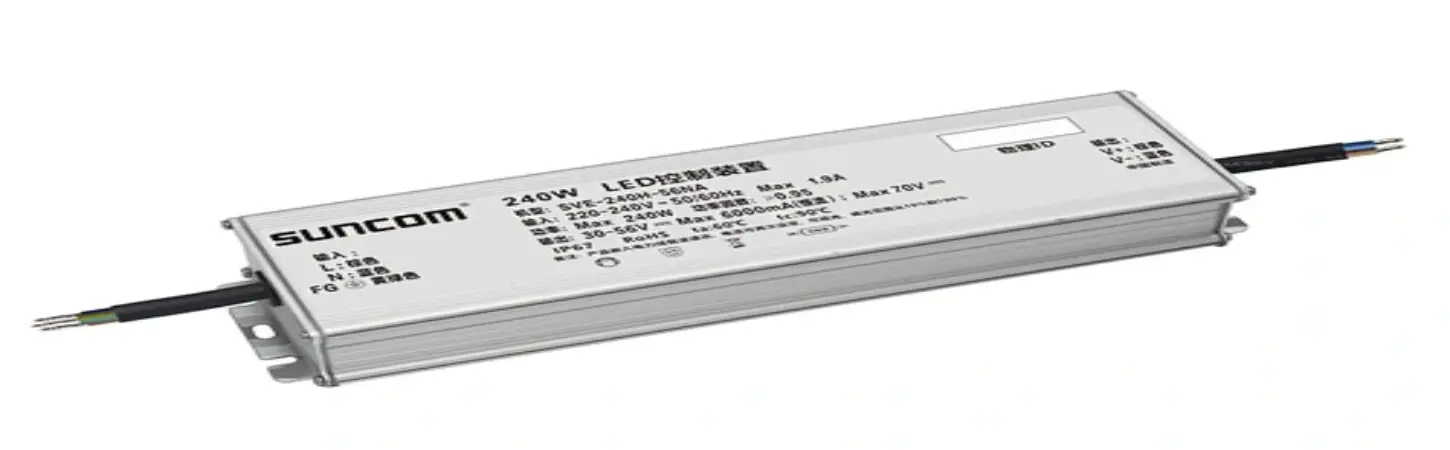
Everything You Need to Know About LED Drivers
2023-10-12
What Is an LED Driver?
LED drivers are power conversion devices used with LED equipment. A light-emitting diode is a small component that emits light using electric current. Light particles called photons are released when current passes through these devices, which produce light of various colours.
Established in 2009, Guangdong Suncom Power is a leading high-tech LED drivers manufacturer. Our brand strategy revolves around a steadfast commitment to becoming a premier LED driver manufacturer, while our development strategy is focused on cost efficiency. Our range of LED driver products finds extensive applications in various sectors, including industrial lighting, street lighting, plant lighting, and smart lighting solutions, among others.
Established in 2009, Guangdong Suncom Power is a leading high-tech LED drivers manufacturer. Our brand strategy revolves around a steadfast commitment to becoming a premier LED driver manufacturer, while our development strategy is focused on cost efficiency. Our range of LED driver products finds extensive applications in various sectors, including industrial lighting, street lighting, plant lighting, and smart lighting solutions, among others.
Browse All LED Drivers

LED Drivers Introduction
LEDs require a reliable power supply to operate. Drivers for LED lights supply this power, converting alternating current (AC) to direct current (DC). They ensure the power supply is constant and uninterrupted by compensating for changes in the temperature and electrical conductivity of the LEDs. This prevents overheating, flickering, colour changes and degraded performance.
LED drivers for lighting also offer thermal shutdown protection - this will switch off lighting altogether if the temperature climbs too high.
Most LED equipment is low Voltage. LED transformers perform the same function for larger lighting systems that require more power.
Alternative names for LED drivers include:
Alternative names for LED drivers include:
- LED power supplies
- LED light drivers
- LED driver circuits
What Does an LED Driver Do?
LED drivers operate like transformers for low voltage bulbs. LEDs are primarily low voltage devices - typically 4V, 12V or 24V - and are intended to be powered by direct current. Since wall socket power supplies usually operate at a much higher voltage (between 120 and 277V) and supply alternating voltage, they are not directly compatible. Specialist LED drivers convert alternating current to direct current since LED voltage is too small for conventional transformers.
Furthermore, LED drivers protect LEDs from power surges and fluctuations that can cause high temperatures and interfere with light output. LEDs are designed for use within a specific amp range.
By selectively switching on and off individual LEDs, LED drivers can also be used for controlling and sequencing the brightness of the LED systems attached and the colors displayed. Normally, white lights are created by displaying LEDs of multiple colors simultaneously - switch on or off some of the LEDs and the white color is no longer visible.
Types of LED Drivers
There are several types of LED drivers, each designed for specific applications and requirements. Here are some common types of LED drivers:
- Constant Current LED Drivers: These drivers maintain a consistent electrical current to the LED, ensuring stable brightness. They are ideal for applications where precise control of light output is essential, such as task lighting and display screens.
- Constant Voltage LED Drivers: These drivers provide a steady voltage to the LED, making them suitable for LED strips, modules, and fixtures that require a fixed voltage supply.
- Dimmable LED Drivers: Dimmable drivers allow users to adjust the brightness of LED lighting. They are often used in residential and commercial settings to create different lighting atmospheres and save energy.
- Flicker-Free LED Drivers: These drivers are designed to eliminate flickering in LED lighting, which can cause discomfort and health issues for some individuals. Flicker-free drivers are commonly used in offices, schools, and healthcare facilities.
- Triac Dimmable LED Drivers: These drivers are specifically compatible with TRIAC dimmer switches commonly found in homes and commercial settings. They enable smooth and reliable dimming control.
- DALI (Digital Addressable Lighting Interface) LED Drivers: DALI drivers allow for advanced control and monitoring of individual or groups of LED fixtures in commercial and industrial applications. They are often used in smart lighting systems.
- 0-10V Dimmable LED Drivers: These drivers are compatible with 0-10V dimming systems commonly used in commercial lighting. They offer precise dimming control and are suitable for large-scale lighting installations.
- PWM (Pulse-Width Modulation) LED Drivers: PWM drivers control LED brightness by rapidly switching the LEDs on and off at different duty cycles. They are common in RGB (color-changing) LED applications.
- Emergency LED Drivers: These drivers provide backup power to LED fixtures during power outages, ensuring emergency lighting functionality in critical situations.
- Wireless LED Drivers: These drivers can be controlled wirelessly through various protocols, making them suitable for smart lighting systems and IoT (Internet of Things) applications.
- AC-DC LED Drivers: These drivers convert AC voltage to the DC voltage required for LED lighting. They are commonly used in household LED bulbs and fixtures.
- DC-DC LED Drivers: DC-DC drivers regulate the voltage and current supplied to LEDs in applications where a stable DC voltage is needed, such as automotive lighting.
Choosing the right type of LED driver depends on the specific lighting application and dimming requirements. Different drivers offer various features and advantages to meet the needs of different projects and installations.
Constant Current vs Constant Voltage LED Drivers
Constant current LED drivers are used when LEDs require a consistent current but have changing voltages due to varying wattage. These drivers adjust the voltage accordingly.
The main amperage options for constant current LED drivers are:
- 350 milliamps (mA)
- 700mA
- 1 amp
For example, a common setup might provide a 700mA current while adjusting the voltage between four and 13 volts in response to a 50-watt load.
These drivers are also called constant power LED drivers and are commonly used for:
These drivers are also called constant power LED drivers and are commonly used for:
- Lighting outdoor features
- High-definition displays in public areas
- Backlighting for billboards
On the other hand, constant voltage LED driver circuits are designed for LEDs that require a steady voltage, typically 10V, 12V, or 24V DC. They work best with LEDs arranged in a linear or string configuration, like lighting strips. LED strip drivers typically have a separate resistor for each LED in the strip, known as a current limiting resistor.
LED Driver Features
LED drivers come in various models, each with its own specifications. These models differ in input and output levels, efficiency, power ratings, and the degree of environmental shielding they provide to safeguard connection terminals.
Let's explore some of the key types:
Let's explore some of the key types:
- Small LED Drivers: These drivers are designed for use with smaller LED lights, typically rated around 4 watts.
- Dimmable LED Drivers: Dimmable LED drivers allow users to adjust the brightness of LEDs, making them ideal for creating mood lighting in places like shops.
- High Power LED Drivers: LED technology continues to advance, with some professional models now offering up to 100 lumens per watt. These high-power drivers are commonly used in larger lighting systems found in commercial and public spaces. They require more robust LED drivers or transformers to ensure smooth operation.
- COB LED Drivers: Chip on board (COB) LEDs consist of multiple LEDs clustered together with integrated circuitry, often featuring dimming capabilities. To power COB LED lights, you'll need a compatible driver or transformer with a sufficient voltage rating. Both constant current and constant voltage drivers can work with COB LED drivers, although constant current models are generally easier to use.
- LED String Drivers: LED string lights typically have smaller bulbs and are commonly used for decorative mood lighting, such as Christmas lights. Mini LED drivers are suitable for these applications, although the total voltage requirements may increase for longer strings.
Selecting an LED Driver
LED drivers come in two primary types: constant current and constant voltage.
Constant Current Drivers: These drivers offer a steady output current and can accommodate a wide range of output voltages. For example, you might find a constant current driver with a 700mA output current and an output voltage range of 4-13V DC.
Constant Voltage LED Drivers: These drivers maintain a fixed output voltage and a maximum regulated output current. They are commonly used to power LED systems that require a consistent voltage, like 12 or 24 Volts DC. A typical driver may provide 24V and a maximum output current of 1.04A.
Constant Current Drivers: These drivers offer a steady output current and can accommodate a wide range of output voltages. For example, you might find a constant current driver with a 700mA output current and an output voltage range of 4-13V DC.
Constant Voltage LED Drivers: These drivers maintain a fixed output voltage and a maximum regulated output current. They are commonly used to power LED systems that require a consistent voltage, like 12 or 24 Volts DC. A typical driver may provide 24V and a maximum output current of 1.04A.
When choosing an LED driver, consider its physical size to ensure it fits where it needs to be installed. Additionally, the Ingress IP rating of the casing tells you how well the driver is protected against moisture, dust, and other external elements.
Other factors to take into account include power factor, maximum wattage, dimming capability, and compliance with international safety standards, such as UL1310, for regulatory compliance.
Understanding Constant Current LED Driver
How Does an LED Driver Work
Related Article
This article explains the core principles of both dimming logics, their hardware implementations, and key practical considerations for field deployment.
Understanding Positive and Negative Logic Dimming in LED Driver
Understanding LED Constant Current LED driver for Outdoor Lighting
LED Constant Current Drivers: The Core Heart of Outdoor Luminaires