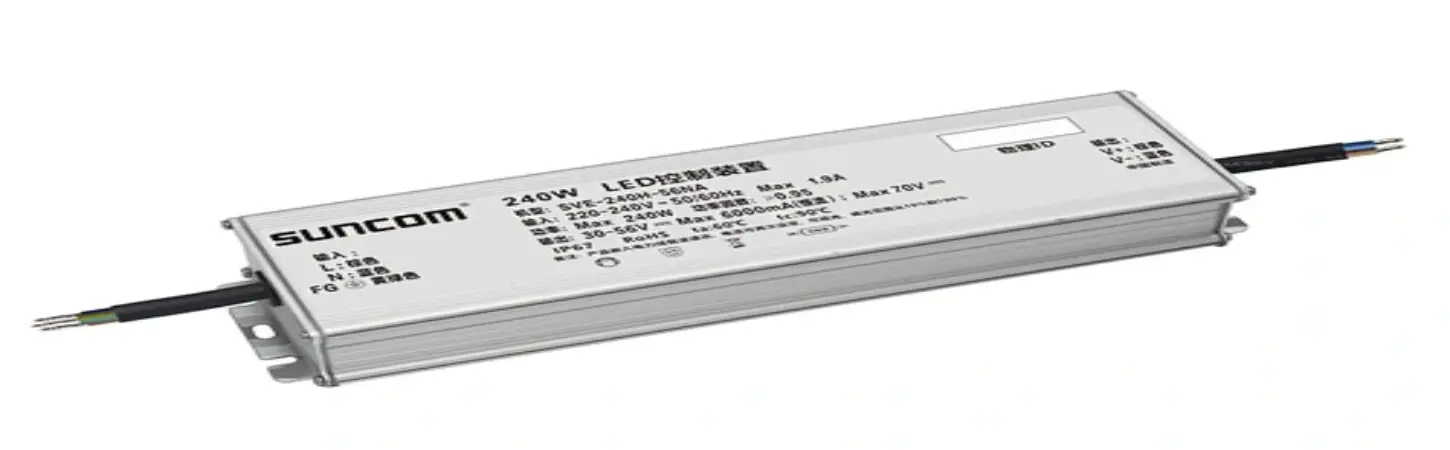
What Is a Programmable LED Driver?
2024-05-09
The market is witnessing an increasing array of LED drivers with programmable features for output current. LED drivers serve as power supplies essential for regulating the power requirements of LEDs. With their programmable capabilities, these drivers enhance the output of current lighting while providing a higher level of hardware flexibility. In this blog post, you'll gain insight into the fundamentals of programmable LED drivers and discover the key parameters to consider.
What is Programmable LED Driver?
A Programmable LED driver offers users the ability to configure output current, dimming mode, timing dimming, CLO, and other functions via computer or cellphone. These drivers have emerged in response to the evolving hardware demands in the market. Lighting designers sought to develop products requiring less inventory while offering greater flexibility. For example, users can adjust the LED driver's output over time while maintaining a consistent power output.
LED drivers play a critical role in safeguarding bulbs from voltage fluctuations by regulating the power necessary for LEDs. They function as power supplies, ensuring operational stability. Indeed, every LED light relies on a driver to maintain it within its operational parameters.
Various types of drivers are available depending on the LED's energy consumption. Internal and external drivers represent optimal choices for safeguarding LED bulbs. What sets programmable LED drivers apart in popularity? They excel at synchronizing the output of household or office lighting with the driver through features such as adjustable output current and dimming curves, which describe how a dimmer adjusts voltage output relative to a control signal input.
LED drivers play a critical role in safeguarding bulbs from voltage fluctuations by regulating the power necessary for LEDs. They function as power supplies, ensuring operational stability. Indeed, every LED light relies on a driver to maintain it within its operational parameters.
Various types of drivers are available depending on the LED's energy consumption. Internal and external drivers represent optimal choices for safeguarding LED bulbs. What sets programmable LED drivers apart in popularity? They excel at synchronizing the output of household or office lighting with the driver through features such as adjustable output current and dimming curves, which describe how a dimmer adjusts voltage output relative to a control signal input.
Benefits of Programmable LED Driver
Programmable LED drivers offer several benefits that contribute to enhanced flexibility, efficiency, and performance in lighting systems:
- Customizable Output: One of the primary advantages of programmable LED drivers is the ability to customize output parameters such as current, dimming levels, and timing. This customization allows for tailored lighting solutions that meet specific requirements for different applications and environments.
- Flexibility: With programmable features, LED drivers can adapt to changing lighting needs and preferences. Whether it's adjusting brightness levels, implementing dynamic lighting effects, or integrating with smart control systems, programmable drivers offer greater flexibility in lighting design and operation.
- Energy Efficiency: Programmable LED drivers enable optimization of energy usage by adjusting output parameters based on real-time conditions and user preferences. This optimization helps to minimize energy consumption while maintaining desired lighting levels, resulting in energy and cost savings over time.
- Enhanced Control: By enabling remote programming and control via computers or mobile devices, programmable LED drivers provide users with convenient access to manage and monitor lighting systems. This remote control capability facilitates easier operation, troubleshooting, and maintenance, especially in large-scale installations or IoT-enabled setups.
- Adaptive Lighting: Programmable drivers support advanced lighting features such as color tuning, dynamic color temperature adjustments, and circadian lighting. These capabilities allow for adaptive lighting schemes that can mimic natural light patterns, enhance visual comfort, and promote well-being in indoor environments.
- Future-Proofing: As lighting technologies and requirements evolve, programmable LED drivers offer a future-proof solution that can accommodate emerging trends and standards. Their versatile nature allows for software updates and feature enhancements, ensuring compatibility and longevity in lighting installations.
Overall, the benefits of programmable LED drivers include increased customization, flexibility, energy efficiency, control, adaptability, and future-proofing, making them an ideal choice for modern lighting applications across various sectors.
Which Parameters Can Be Programmed?
The technology sector continually innovates to enhance the functionality of devices. A primary requirement for LED drivers is the ability to adjust circuit output current, driving the demand for programmable LED drivers. As a result, numerous key features have emerged in LED lighting, offering various parameters for programming.
Several notable programmable functions can be incorporated into the LED driver you're utilizing. Below are some examples:
Output Current
This parameter specifies the maximum current supplied to the load. Load regulation indicates the regulator's ability to maintain output stability despite load changes. LED drivers serve as an interface between the load and the power supply line, accommodating alternating current voltages ranging from 120 to 480 volts and converting them to direct current output.
Dimming Mode
Dimming modes allow users to adjust the brightness of a light. Dimming typically involves reducing the leading current in a driver or utilizing pulse width modulation. Most dimming modes employ this method to prevent flickering and unwanted changes in color temperature.
Timer Dimming
Timer dimming controls the speed of LED switching and is typically positioned early in the circuit. It facilitates smart control and energy conservation, with dimmers installed between the timer and the light source.
NTC (Negative Temperature Coefficient)
NTC, or Negative Temperature Coefficient, refers to a resistor whose resistance decreases as temperature increases. These resistive temperature sensors are commonly utilized in various devices to monitor temperature changes.
CLO (Constant Lumen Output)
CLO, or Constant Lumen Output, helps maintain consistent light levels and prolong LED lifespan. As LED luminous flux naturally diminishes over time, CLO programmable drivers effectively compensate for this light depreciation.
How to Program an LED Driver?
The choice of how to program your LED driver depends on the balance between cost and reliability that you prioritize.
By NFC
NFC offers a straightforward programming method by wirelessly configuring the dimming levels and lumen output of the LED driver, eliminating the need to power the drivers during programming.
To begin, launch the software and establish a connection between the NFC program and a computer. Once connected, click the "read" button to initiate programming through the NFC window. Select PWM dimming and specify the desired current, then proceed by clicking the appropriate buttons to configure time dimming and dimming curve settings. Enable Constant Lumen Output and set the current and time values accordingly before finalizing the process by clicking the appropriate buttons. Don't forget to stop the action by clicking the stop button upon completion. Finally, enable external thermal protection by setting the resistor value and the directed value, and complete the programming process by clicking the relevant buttons.
To begin, launch the software and establish a connection between the NFC program and a computer. Once connected, click the "read" button to initiate programming through the NFC window. Select PWM dimming and specify the desired current, then proceed by clicking the appropriate buttons to configure time dimming and dimming curve settings. Enable Constant Lumen Output and set the current and time values accordingly before finalizing the process by clicking the appropriate buttons. Don't forget to stop the action by clicking the stop button upon completion. Finally, enable external thermal protection by setting the resistor value and the directed value, and complete the programming process by clicking the relevant buttons.
By Cable
In the past, a potentiometer was commonly used to adjust LED driver programming, but now cable programming provides an alternative method. Begin by connecting the programmer to the computer via a USB cable. Ensure the LED driver's dimming wires (purple for positive and gray for negative) are connected to the cable programmer's corresponding terminals (red for positive and black for negative). Download the PC software and launch the GUI (Graphics-based User Interface) by clicking on Programming utility V1.1.exe in Windows. Select the "read" button to verify correct output current and model information. Then, set the output current in the reset current function area and finalize the programming process by clicking the "write" button.
By Potentiometers
Potentiometers, commonly referred to as pots, are variable resistors integrated with a knob mechanism that translates rotational motion into changes in electrical resistance within a circuit. They are frequently employed for adjusting electrical signals, such as volume control. To program a LED driver using a Potentiometer, begin by identifying the three terminals. Then, adjust the Potentiometer until the shaft points towards the ceiling and the terminals face towards you.
By Cellphone
Programming your LED driver via cellphone, particularly with NFC technology, is another convenient option. First, download the app required for programming and ensure that your phone supports NFC. Once installed, activate the NFC function on your phone and open the app. Tap the "Read" button within the app and then touch your phone to the NFC window on the LED driver. Once successfully read, set the desired current and touch the NFC window again to complete the programming process.
What is Constant Power LED Driver?
Many programmable LED drivers are designed to maintain constant power output, enhancing their functionality. The constant power LED driver (CP) is tasked with delivering a broad spectrum of current and voltage, serving as a preventive measure against unnecessary costs associated with damage. Lowering the programmed output current results in a higher maximum output voltage for the LED driver, ensuring that the maximum output power remains consistent.
Due to increasing demand for LED drivers, CP has gained significant popularity for its superior operational flexibility. It ensures constant power output even under peak load conditions, making it safer to manage LEDs at higher currents compared to other LED drivers lacking CP functionality.
This driver type embodies a practical design approach, as it doesn't require numerous models to excel in various projects.
Due to increasing demand for LED drivers, CP has gained significant popularity for its superior operational flexibility. It ensures constant power output even under peak load conditions, making it safer to manage LEDs at higher currents compared to other LED drivers lacking CP functionality.
This driver type embodies a practical design approach, as it doesn't require numerous models to excel in various projects.
Summary
Today, programmable LED drivers serve as the central component of modern LED lighting systems. They play a crucial role in load regulation and power conversion, making them indispensable. Additionally, their installation is simplified due to their hardware flexibility. Their programmable capabilities, including output current and dimming curve adjustments, enhance manageability and profitability for LED drivers.
The Ultimate Guide to Smart Streetlights
Choosing LED Drivers for High Heat Applications
Related Article
This article explains the core principles of both dimming logics, their hardware implementations, and key practical considerations for field deployment.
Understanding Positive and Negative Logic Dimming in LED Driver

Understanding LED Constant Current LED driver for Outdoor Lighting
LED Constant Current Drivers: The Core Heart of Outdoor Luminaires